Large Language Model from Scratch
Go from tensors and gradients all the way to a working LLaMA-style decoder. This teaching lab covers PyTorch fundamentals, every transformer component (tokenisation, attention, normalisation, FFN), efficiency techniques (FlashAttention, MoE, LoRA), training pipelines, and inference optimisation — all designed to run on AMD GPUs.
Goals
- Master PyTorch fundamentals: forward pass, backpropagation, and training loops
- Understand every component inside a Transformer block (RoPE, RMSNorm, MHA, SwiGLU)
- Apply efficiency techniques: FlashAttention, MoE, LoRA, and quantization
- Build complete training and inference pipelines with KV-Cache optimisation
- Assemble a Tiny LLaMA from scratch as a capstone project
Foundations (LLM01 to LLM03)
What this section covers
Introduction to LLM inference, forward propagation, and backpropagation with autograd.
LLM01 — LLM Introduction and Inference
Load pre-trained models, tokenize text, and run autoregressive text generation.
LLM02 — Forward Propagation
Tensor operations, linear layers, activations, and the building blocks of the forward pass.
LLM03 — Backpropagation and Autograd
Computation graphs, gradient verification, and complete training loops.
Transformer Components (LLM04 to LLM06)
What this section covers
Tokenisation, positional encoding, normalisation, FFN, and attention mechanisms.
LLM04 — Tokenization and Positional Encoding
Tokenizers, embeddings, sinusoidal encoding, and Rotary Position Embedding (RoPE).
LLM05 — Normalization and FFN
Layer norm, RMS norm, SwiGLU FFN, and Pre-LN vs. Post-LN comparisons.
LLM06 — Attention Mechanisms
Scaled dot-product attention, causal masking, MHA, and Grouped Query Attention (GQA).
Efficiency and Adaptation (LLM07 to LLM09)
What this section covers
FlashAttention, Mixture of Experts, numerical precision, and LoRA fine-tuning.
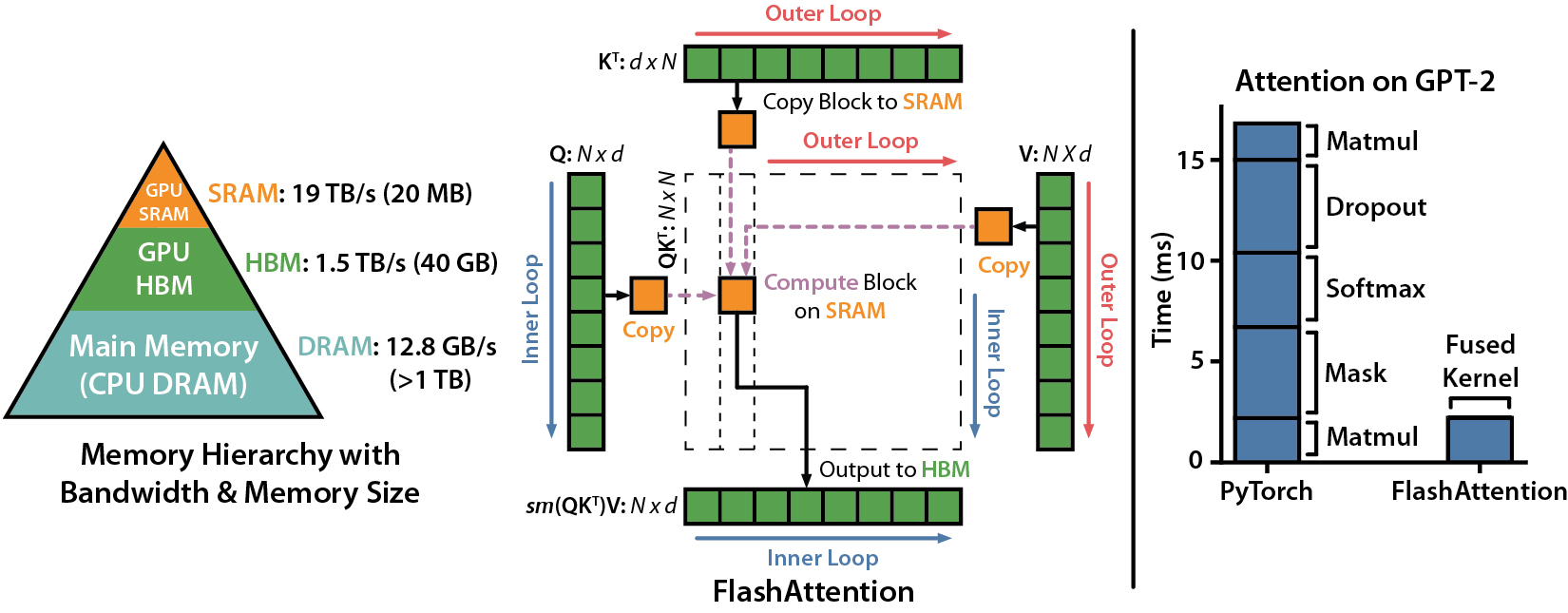
LLM07 — FlashAttention
GPU memory hierarchy, tiling, and IO-aware attention optimisation.
LLM08 — MoE and Numerical Precision
Mixture of Experts architecture and floating-point / quantization formats.
LLM09 — LoRA Fine-Tuning
Parameter-efficient adaptation with Low-Rank Adaptation layers.
Training and Data (LLM10 to LLM11)
What this section covers
Data pipelines, model packaging, and end-to-end training workflows.
LLM10 — Data Processing and Model Packaging
Dataset preprocessing, state_dict, safetensors, and HuggingFace model wrapping.
LLM11 — Model Training Pipeline
Collate functions, loss functions, AMP, gradient accumulation, and HuggingFace Trainer.
Inference and Serving (LLM12 to LLM13)
What this section covers
Decoding strategies, KV-Cache, sparse attention, and PagedAttention.
LLM12 — Inference and KV-Cache
Prefill vs. decode, decoding strategies, and KV-Cache implementation.
LLM13 — Sparse Attention and PagedAttention
Sliding window attention, attention sinks, and block-based KV memory management.
Capstone (LLM14)
What this section covers
Assemble a complete LLaMA-style transformer from scratch.
LLM14 — Build a Tiny LLaMA from Scratch
Full model implementation with RoPE, RMSNorm, MHA, SwiGLU, training, and text generation.
Continue with Physical AI, Computer Vision, Deep Learning, LLM from Scratch.